
Used Concrete Pump Truck Buying Checklist: How to Inspect Before You Buy
A used concrete pump truck combines a road truck with a high-pressure pumping system and, on boom pumps, a long steel placing boom. The truck and the pump age in different ways, and a problem in either one can keep the machine off the job.
This guide helps buyers screen used truck-mounted concrete pumps and prepare the scope of an inspection. It is not a repair manual, an engineering inspection standard or an inspection report. It does not replace the manufacturer’s manual, a qualified technician, an independent inspection or the rules in your country. The aim is to help you ask better questions and decide which machines deserve a closer look.
A note on safety: functional tests should be carried out only by competent personnel, under safe site conditions and in accordance with the manufacturer’s instructions and applicable site procedures. Nothing in this guide asks a buyer or seller to operate the machine themselves.
The checklist at a glance
| Area | What to look at | What to ask for |
|---|---|---|
| Identity and documents | Model, production date, chassis/VIN, ownership | Readable photos of the equipment nameplate, chassis plate and registration documents |
| Operating data | Pumping or power-on hours, standby hours, total pumped volume, pumping cycles | A recent photo or video of the onboard display |
| Boom and structure | Boom sections, joints, turret area, weld repairs | Close-up photos and inspection and repair records |
| Outriggers | Legs, boxes and cylinders | Photos, plus a deployment video recorded by competent personnel |
| Pumping unit | Hopper, S-valve, wear plate, cutting ring, pistons, delivery cylinders | Photos and replacement records |
| Hydraulics | Visible leaks, hoses, main pump nameplate | Photos, plus a running video recorded by competent personnel |
| Delivery pipeline | Pipes, clamps, end hose | Any wall-thickness test records |
| Controls | Remote control, emergency stops, display warnings | Photos of the display, plus a test video recorded by competent personnel |
| Truck chassis | Engine, gearbox, PTO, brakes, tyres, odometer | Chassis photos, an engine start video and service records |
| Export and import | Destination rules, documents, shipping | Written confirmation before you pay |
The sections below explain each line. The specific inspection methods and acceptance limits for each area should be set by a qualified technician for the model you are considering.
1. Confirm identity and paperwork first
Before you spend time on condition, make sure the machine is what the listing says it is.
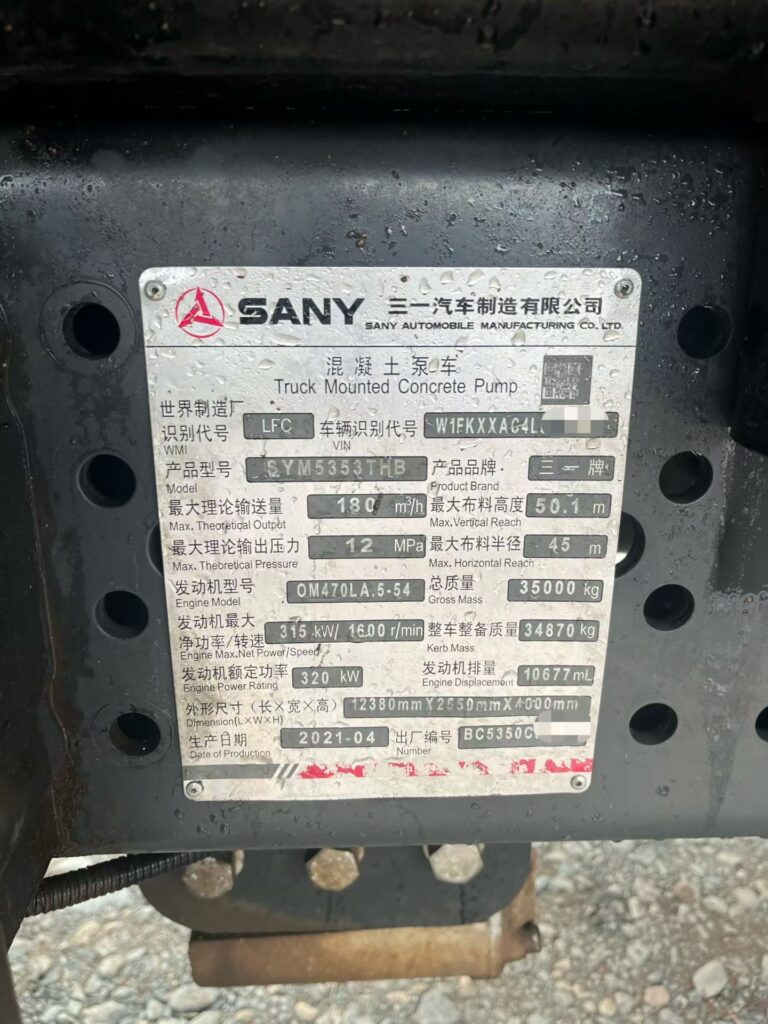
- Equipment nameplate. The pump nameplate typically records the model, production date and main ratings. Compare it with the listing and the seller’s documents. For example, the nameplate photographed for one SANY SYM5353THB C10 listed on our site shows an April 2021 production date, 50.1 m maximum vertical reach and 180 m³/h maximum theoretical output. Like any listing, those details are subject to reconfirmation for the actual unit.
- Chassis plate and VIN. The pump and the truck chassis can come from different manufacturers. SANY truck-mounted pumps listed on our site, for example, are mounted on Mercedes-Benz Arocs, SANY and Dongfeng Tianjin chassis. Check that the chassis plate matches the registration documents.
- Ownership. Ask who owns the machine and whether it is free to sell.
- Photos of the actual unit. Ask whether each photo shows the actual machine or a representative model. Some listings use a presentation image on the listing card. Base your decisions on photos and videos of the actual unit, not on a presentation or AI-generated image.
2. Read the operating data correctly
A concrete pump’s onboard display may record more than one type of operating-time figure.
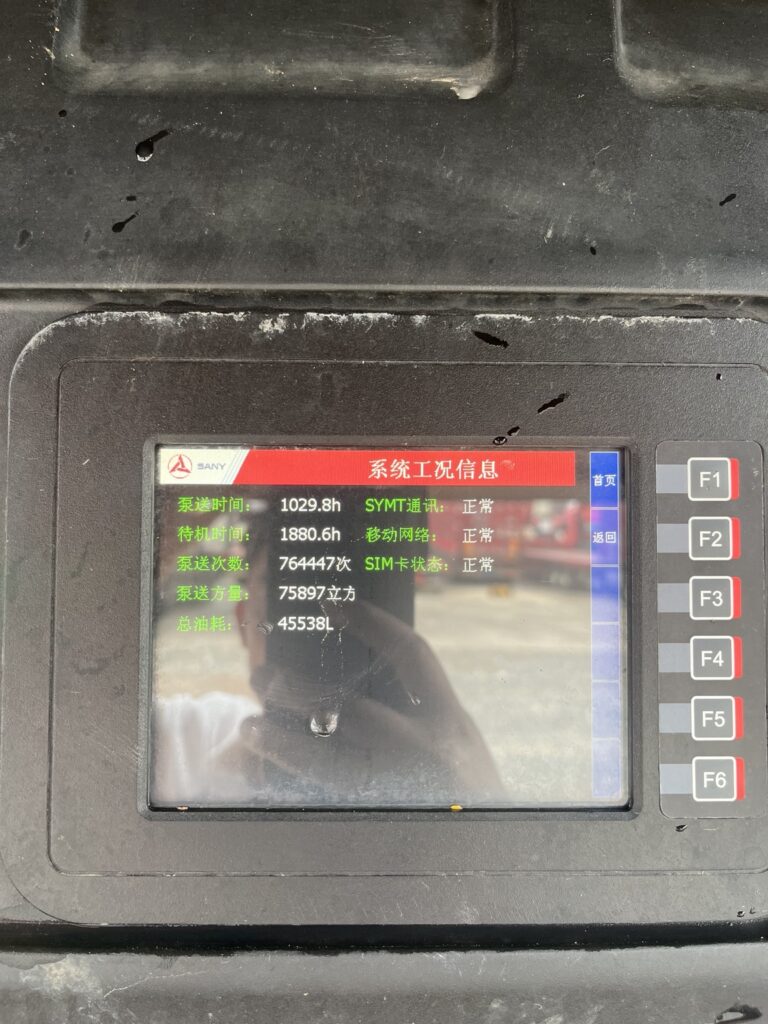
- Pumping or power-on time and standby time. On the SANY displays photographed for our listings, pumping (or power-on) time and standby time are shown as separate readings. Record these figures separately and ask a qualified technician to interpret them according to the manufacturer’s documentation and the specific control system.
- Total pumped volume and pumping cycles. These give a second view of how much work the pumping unit has done, alongside the hours.
- Fuel consumption. Record this figure together with the operating data and ask a qualified technician to review whether the readings appear consistent.
- Chassis odometer and engine data. These come from the truck, not from the pump control system, so ask for them separately.
For example, the display photographed for the same SANY SYM5353THB C10 shows 1,029.8 pumping hours, 1,880.6 standby hours and 75,897 m³ of cumulative pumped volume. Readings like these tell you which questions to ask, such as which wear parts have been replaced and when. They do not confirm the machine’s condition, and they change if the machine is still working. Ask for a recent photo or video of the display, and ask a qualified technician to review the figures against the service records.
3. Boom and structure
On a boom pump, the placing boom deserves particular attention. Australia’s Queensland workplace safety regulator notes that concrete placing booms can be prone to metal fatigue and cracking because the pulsating action of the pump creates a high degree of cyclic loading. In one case it reported, a 32 m boom collapsed after a crack in the king post (slewing turret) had grown through about 40% of its cross-section. That machine was more than 30 years old. The case does not suggest that newer machines share the same problem, but it shows why fatigue-sensitive structural areas and inspection history matter on any used placing boom.
What to ask for:
- Close-up photos of the boom sections, joints and turret area, taken with the boom safely rested or folded
- Photos and an explanation of any visible weld repairs, reinforcement plates or fresh paint over structural areas
- Photos of the pins, bushings and boom cylinders
- Inspection and repair records for the boom
- A video of the boom moving through its range, recorded only when competent personnel carry out the test, under safe site conditions and in accordance with the manufacturer’s instructions and applicable site procedures
Photos and videos have limits. Some structural defects are internal or hidden under paint, and a visual check or functional test may not reveal them. That is why Queensland’s rules for its own jurisdiction include a major inspection with strip-down of high-stress areas, in addition to daily and annual checks. Queensland requires that major inspection once equipment is six years old, and every six years after that.
Other jurisdictions have their own frameworks. In the United States, ASME B30.27 is the consensus standard for material placement systems, which include concrete pump placing booms. In Europe, EN 12001 sets safety requirements for machines that convey, spray and place concrete. Some manufacturers also set boom inspection intervals by machine age and working hours. These frameworks apply in their own markets and are not universal legal requirements, but they show the kind of records a careful owner keeps. Which methods and limits apply to a particular boom should be decided by a qualified technician.
4. Outriggers
The outriggers keep the machine stable when the boom is extended.
- Photos of the outrigger legs, boxes and cylinders, showing any bends, cracks or repairs
- A video of the outriggers deploying and retracting, recorded only when competent personnel carry out the test, under safe site conditions and in accordance with the manufacturer’s instructions and applicable site procedures
- Any related warnings shown on the display
5. Pumping unit and wear parts
The main wear areas of the pumping unit include the hopper, the S-valve (S-tube), the wear plate, the cutting ring, the concrete pistons and the delivery cylinders.
Wear-part life varies with machine configuration, material, operating conditions and maintenance history. Confirm the applicable inspection and replacement guidance for the specific model.
What to ask for:
- Photos inside the hopper showing the S-valve, wear plate and cutting ring. Photos inside the hopper should be taken only when the machine is shut down and isolated in accordance with the manufacturer’s instructions and the applicable site safety procedure.
- Replacement records for the main wear parts
- A video of the pump cycling, recorded only when competent personnel carry out the test, under safe site conditions and in accordance with the manufacturer’s instructions and applicable site procedures
A qualified technician should judge wear and replacement needs for the specific model.
6. Hydraulic system
- Photos of the main pump, valves, boom cylinders and hoses, showing any visible leaks or damaged hoses
- The nameplate details of the main hydraulic pump
- A running video, recorded only when competent personnel carry out the test, under safe site conditions and in accordance with the manufacturer’s instructions and applicable site procedures
A video can show visible leaks or obvious faults. It cannot confirm that the hydraulic system is in good working order. Pressure checks and oil condition should be assessed by a qualified technician.
7. Delivery pipeline and end hose
Delivery pipe wears from the inside, which is hard to see from the outside.
- Wall thickness. For workplaces in Queensland, the regulator advises that pipe with less than the recommended wall thickness for the pumping design pressure should not be used. It also notes that ultrasonic testing may not suit twin-wall pipe.
- Twin-wall pipe. In a late-2023 incident reported by the same regulator, the inner wall of a twin-wall pipe had worn away in places and the pipe ruptured. The regulator advises getting discard criteria from the manufacturer.
- Clamps, gaskets and end hose. Ask which items are included in the sale and whether any test records exist.
If the seller has no pipe thickness records, include pipeline checks in the inspection scope and let a qualified technician decide the method.
8. Controls and safety devices
- Photos of the onboard display, including any active warnings, with the seller’s explanation of each one
- A video of the remote control and of each emergency stop being tested, recorded only when competent personnel carry out the test, under safe site conditions and in accordance with the manufacturer’s instructions and applicable site procedures
Fault codes and control-system diagnostics should be read and interpreted by a qualified technician.
9. Truck chassis
The chassis needs the checks you would make on any used heavy truck:
- Engine start video and a view of the exhaust
- Gearbox and PTO engagement, recorded only when competent personnel carry out the test, under safe site conditions and in accordance with the manufacturer’s instructions and applicable site procedures
- Brakes, tyres, suspension, cab and chassis frame
- Odometer reading and service records
10. Plan the inspection
If you cannot inspect the machine in person, consider appointing a qualified independent inspector and define the inspection scope in writing. The scope should state which areas are covered, whether functional tests are included, and what the report will and will not cover.
A structured request for photos and videos helps you decide which units are worth inspecting:
- Walk-around video of the whole machine
- Readable equipment nameplate and chassis plate
- Onboard display showing hours, volume and cycles
- Close-ups of boom joints, the turret area and any weld repairs
- Inside the hopper, with the machine shut down and isolated
- Truck engine start
Functional videos of the boom, outriggers, PTO and pumping, remote control and emergency stops should be recorded only when competent personnel carry out the tests, under safe site conditions and in accordance with the manufacturer’s instructions and applicable site procedures.
An inspection report normally describes the observed condition at the time of inspection and should not be treated as a warranty unless the relevant contract expressly states otherwise.
11. Export and destination checks
Import rules for used trucks and used construction equipment differ by country. Confirm the rules that apply in your country with a customs broker or qualified destination agent before you commit to a machine.
Before you pay, also confirm in writing:
- Which export documents will be provided, and who prepares them
- How the machine will be shipped, and what that will cost
- Who is responsible for each step
How Global Drive Solution can help
Global Drive Solution is not the equipment manufacturer or an authorized dealer for the brands referenced. Depending on the agreed scope, we can assist with equipment sourcing, supplier verification, collection of available unit-specific photos and videos, inspection coordination, and export or shipping coordination.
- Every service is carried out for the specific project and within the scope agreed.
- For third-party inspections, who appoints the inspector, who pays, the inspection scope and the report format should be confirmed in writing before the inspection is commissioned.
- Availability, condition, completeness of documents and delivery timing must be reconfirmed for each unit.
- We do not guarantee machine condition, availability, delivery dates, import approval or customs clearance.
You can browse our used concrete pump truck listings. Every listing is subject to reconfirmation.
Points to keep in mind
- Photos and display readings are information to review, not proof of condition.
- A visual check or functional test may not reveal hidden or internal structural defects.
- A listed unit may be sold, used further or moved before you pay. Reconfirm availability and readings close to the purchase date.
- The regulatory examples in this guide (United States, Europe, Queensland) apply in their own jurisdictions. The rules where you operate the machine are the ones that apply to you.
FAQ
What should I check first on a used concrete pump truck?
There is no single check that replaces a complete inspection, but the boom structure and its inspection history deserve particular attention because structural failure can have severe consequences.
Are pumping hours the same as engine hours?
No. On the SANY displays reviewed for our listings, pumping or power-on time and standby time are shown as separate readings. Other control systems may record operating data differently, so ask for each figure and have it interpreted for the specific machine.
Can photos and videos confirm that a pump truck is in good condition?
No. They help you screen machines and plan an inspection. Hidden structural defects, hydraulic condition and wear limits need assessment by a qualified technician.
What if I cannot inspect the machine in person?
Consider appointing a qualified independent inspector and define the inspection scope in writing before the inspection takes place.
Do I need to check my country’s import rules first?
Yes. Rules differ by country. Confirm them with a customs broker or qualified destination agent before you commit to a machine.
Reviewed by Ryan Xie, Global Drive Solution (Singapore)
Send us your requirements
Send us the equipment model, destination country and your specific requirements.